For some consumers, “local food” is getting a bit simpler: Find a nearby farm, buy the food, and support the farmers growing it. But for restaurants, sourcing locally can be considerably more complicated.
Restaurants need a reliable supply of ingredients, predictable inventory, easy ordering and delivery, and prices that work within already-tight margins. That’s one reason many rely on large food distributors (most of which get their supply from factory farms) that can deliver nearly everything they need with the click of a button.
Local Source is trying to make the local alternative just as easy.
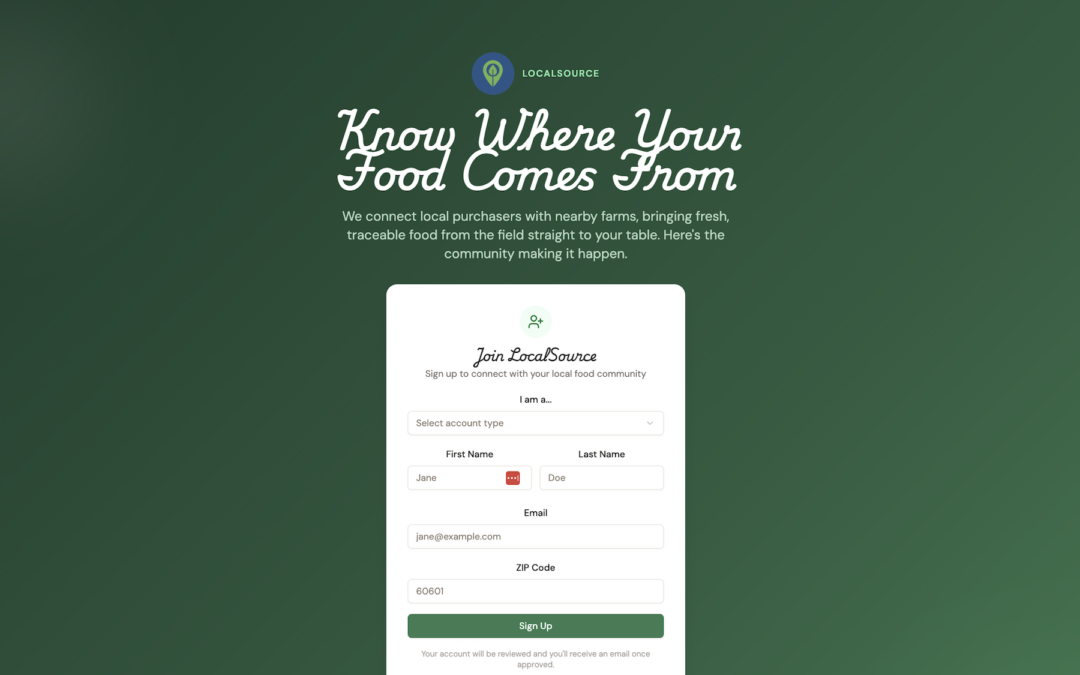
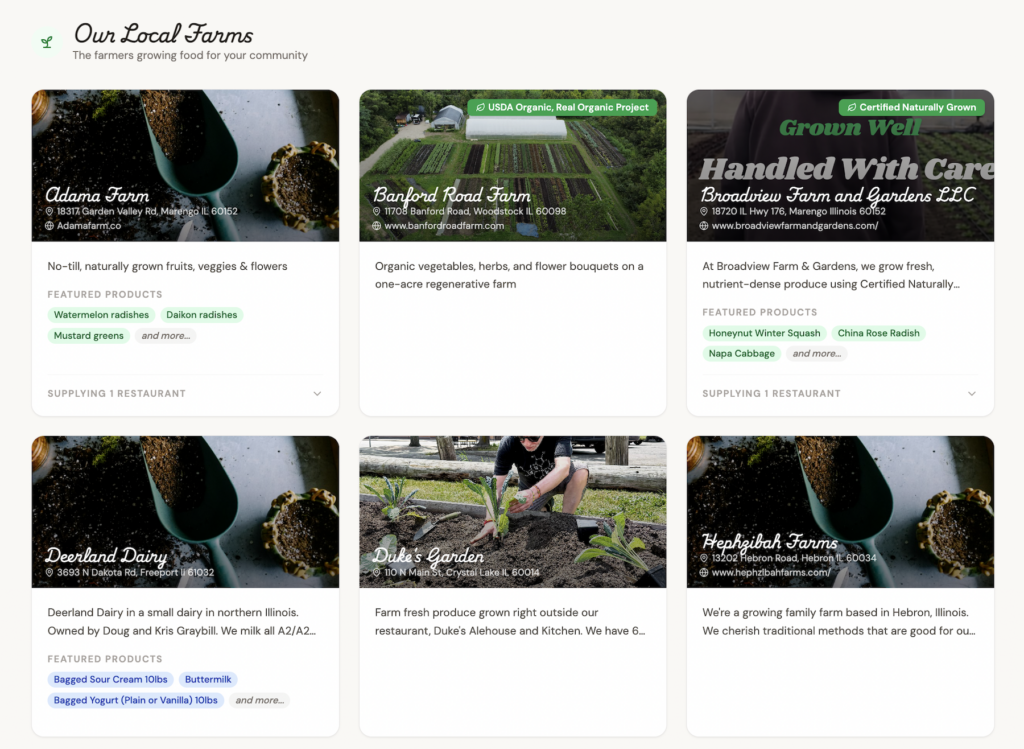
The new business-to-business app connects restaurants directly with local farmers and food producers, allowing chefs and restaurant owners to see what’s available, search for products based on their needs, and communicate directly with producers. Rather than processing transactions itself, Local Source is designed to be the bridge between the two.
The platform is currently focused on McHenry County, Illinois, with ambitions to expand into Cook County and Chicago and, eventually, communities across the country.
Local Source founder Zak Dolezal, chef-owner of Duke’s Alehouse and Kitchen in Crystal Lake, IL is dedicated to environmental stewardship both in and out of the kitchen and prioritizes local sourcing, sustainable agriculture, and humane farming practices. We spoke with him about the problem he’s trying to solve, why restaurants can be hesitant to source locally, and his vision for creating a food system in which choosing local is simply the easy choice.

What exactly is Local Source?
“Local Source is a business-to-business app built to connect restaurants and local producers. We’re trying to bridge that gap and make the introductions while simplifying ordering for restaurants and communication with farms.
“The idea is to create a one-stop shop where restaurants can find as many local products as possible as well as have an easy way for farms to receive orders and communicate directly with restaurants.
“We’re not a transaction platform, so we don’t take any money from the transactions. We’re simply creating the connection between businesses and local producers.
Right now, we’re focusing primarily on meat, dairy, eggs and produce.”
Why do restaurants need something like this?
“Most restaurants are ordering everything from one or two different purveyors. Companies like Sysco, U.S. Foods and Testa Produce have their own ordering systems, and it’s incredibly easy. A restaurant can order everything it needs at once, and those products can come from across the country—or even across the world.
“Meanwhile, that same product might be grown right down the street.
“The problem is that restaurants often feel like sourcing locally is going to require more time. They think, ’I have to make a phone call. I have to send an email. I have to keep track of all these different numbers.’”
“We’re trying to make it a simple, easy alternative to what they’re already doing.
“If a restaurant needs heirloom tomatoes, for example, they can search the app and find several local producers offering them. The app also tracks inventory, so farmers can update their availability and restaurants don’t end up ordering something that’s already sold out.”
Who are you hoping will use Local Source?
“While it’s really for every restaurant, it will be especially attractive to restaurants that are interested in exploring local sourcing but haven’t been able to make it work.
“Restaurants that are already doing it are willing to put in the effort. We’re not trying to reinvent the wheel for them. We want to make it easier for everyone else.
“A lot of chefs I talk to are interested in local food. They’ll say, ‘I just don’t have access to it,’ or ‘I don’t have time,’ or ‘I can’t convince my manager to do it.’”
“We’re trying to remove those barriers.”
What about organic, pasture-raised or other specific farming practices?
“That’s one of the things we really want to focus on: transparency. You can find products marketed as local or sustainable through some of the big distributors, but you may not know much about the actual farm or its farming practices.
“With Local Source, restaurants can search based on different parameters. Maybe they’re looking specifically for an organic farm. Maybe they want pasture-raised products. Maybe they simply want something produced as close to their restaurant as possible.
“The goal is to create transparency around where the food is coming from and how it’s produced.”
How does Local Source help farmers?
“Local Source gives them marketability and raises awareness that they’re offering products in their area.”
“It’s free for farmers to be on the platform, because I don’t want to create any resistance for them. This is another way for them to get the word out about what they have available. A lot of this started because I saw the need from farmers who were just starting out. They might say, ‘We want our products in your restaurant. How do we get in front of more restaurants?’”
“I think about the amount of work and money that goes into starting a farm. I don’t want to see somebody put all that work into their land and their business and then struggle financially a couple of years later because they couldn’t find enough customers. If we can help connect those newer farms with reliable restaurant customers, that can make a real difference.”
Local food can sometimes cost more. How do you address that concern for restaurants?
“The ingredients are going to be more expensive. There’s no getting around that. That said, I think the marketability of those ingredients can outweigh the additional cost. We’ve been a successful business for almost two decades, and we’ve been doing farm-to-table since 2008. You can be a mom-and-pop restaurant, support local farms and still be successful.
“The key is letting customers know what you’re doing.
“That’s why we built a QR-code feature that restaurants can put directly on their menus. Customers can scan it and see where the restaurant is getting its food.
“We can also track things like food miles saved, which can be translated into carbon savings, as well as the amount of packaging restaurants are diverting from landfills through reusable packaging.
“The idea is to give customers a reason to feel good about where they’re eating—and give restaurants a way to demonstrate the value behind the additional cost of sourcing locally.”
So Local Source is more than an ordering platform?
“Absolutely. We knew we needed to add value beyond just ordering.
“We send weekly emails highlighting local ingredients that are available, and we feature a farmer every month and a restaurant every month. Within the app, users can see the restaurants, farms and products that are participating. Restaurants and farms can also earn different certifications and badges that recognize greener practices.
“It’s not really about putting people against each other. It’s about encouraging businesses to improve their practices and making it easier for people to find the kind of producers they’re looking for.”
Where is Local Source currently available?
“Right now, we’re operating within McHenry County. The next step I’d like to take is into Cook County and Chicago. If we can develop the system there, I think the sky’s the limit. Ultimately, I envision this being something that could eventually be used nationally. I think that’s what will make it most valuable.
“Eventually, I’d like someone to be able to go anywhere in the country, open Local Source and see which restaurants are sourcing locally in their community.”
What’s your bigger vision for the app?
“I’d like to see a future where restaurants are ordering from local farms as often as—or even more often than—they’re ordering from broadline distributors.
“There’s always going to be a need for conventional food and the large distributors. But when a local product is available, I want restaurants to be able to easily choose the local option. I also don’t want local food to feel like some bougie, elitist food trend. This is about getting money back into the farming community, which is a necessity.
“And if we do it right, there’s a bigger environmental impact. Regenerative farming and carbon sequestration can play a role in addressing climate change. Food has the potential to make a huge impact on our environmental future.
“So, the biggest-picture goal is to create something that makes a real dent in the environmental damage caused by our current agricultural system.”
What does the future look like for Local Source?
“First, we need to get more restaurants in our county using it. Then I’d like to expand into a larger market like Cook County and Chicago.”
“As we grow, we’ll also be able to collect more data from all these businesses. That can become really valuable because we’ll be able to see the demand for local food and demonstrate what happens when businesses begin shifting toward more sustainable and regenerative agriculture.
“Ultimately, I want to build a stronger support system for local farms and make it easier for restaurants to participate in the local food movement. If we can make local sourcing as simple as ordering from a broadline distributor, maybe choosing local stops being the exception—and becomes the norm.”
Connecting Restaurants, Farmers—and Consumers
Local Source is focused on one important piece of the local food system: making it easier for restaurants to connect directly with nearby farms and producers. For Crate Free USA, that connection matters for another reason, too. Knowing where our food comes from—and how the animals who produce our food are raised—is an important part of making more informed food choices.
We’re working toward that same goal on the consumer side. Crate Free USA’s own local farm app helps consumers find farms and other sources of pasture-raised meat, dairy and eggs, with a map showing where these products are available in Illinois.
Whether you’re a restaurant looking for a nearby farmer or a consumer looking for more responsibly raised food, making those connections easier is an important step toward a more transparent and humane food system.