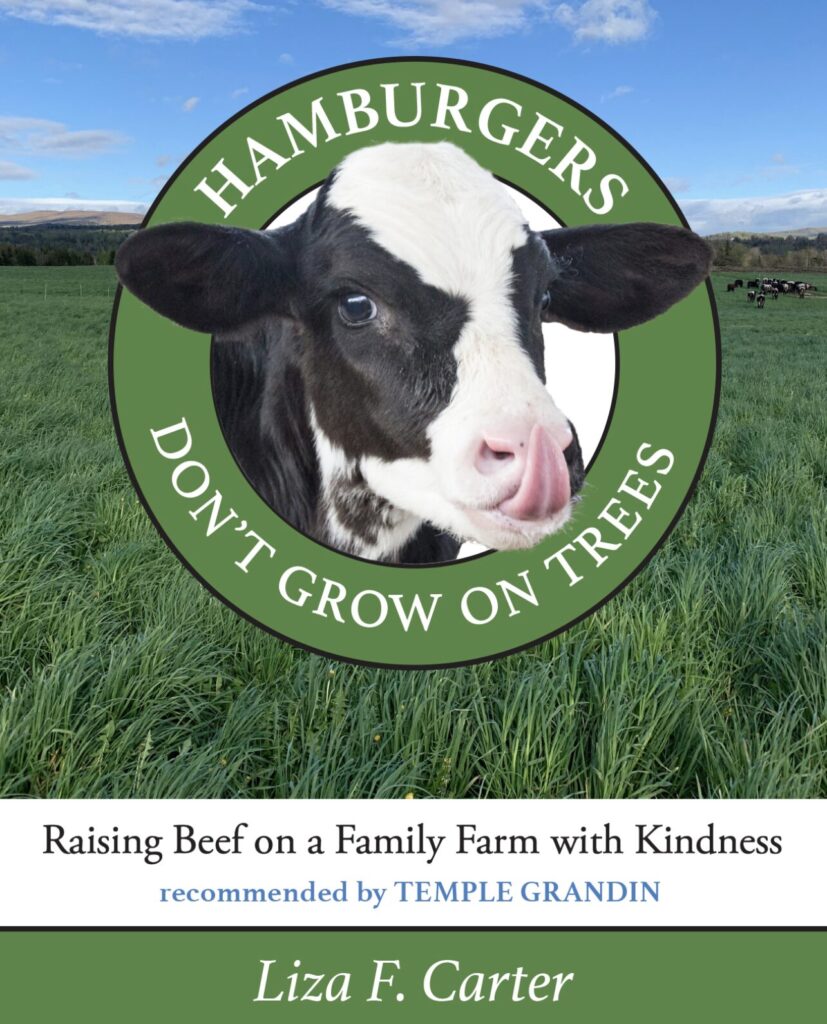
“This book provides a real service. Animals have got to have a life worth living and children need to know where meat comes from,” Temple Grandin, Animal Welfare Champion, recently said about the newly published book, Hamburgers Don’t Grow on Trees: Raising Beef on a Family Farm with Kindness.
Environmental scientist, writer and artist, Liza F. Carter, wrote this book to inspire thoughtful conversations about raising meat in ways that honor the animals, respect the farmers, and care for the land. Liza’s work bridges art and environmental advocacy. With a deep belief in the power of art to foster a caring connection to the natural world, she uses her creative talents to inspire stewardship and appreciation for nature and animals.
The book follows the life of Lima Bean, a bull calf born on a dairy farm who gets to live at Snug Valley Farm, where Nancy and Helm Nottermann raise grass-fed beef and pasture-raised pigs.
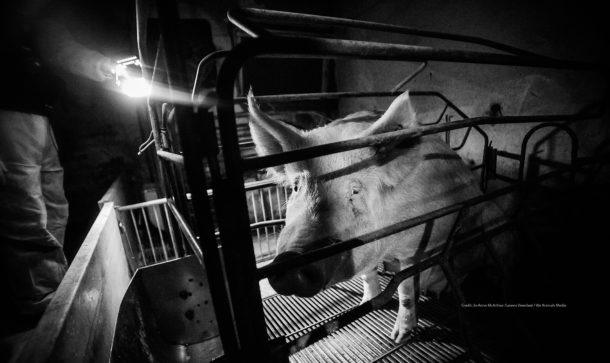
In the past, almost all animals raised for meat in the United States had a life like Lima Bean’s. Sadly, that is no longer the case for ninety-nine percent of the meat animals raised here. Even though advertisements for meat show “happy” cows, pigs, chickens, and lambs roaming freely on beautiful farms, most animals are raised in factory farms or on feedlots. Often, thousands of animals are crowded together in conditions of unimaginable cruelty and poor health. They are treated like machinery that happens to “produce” food, not living creatures that experience pain and fear.
Conditions in these factory farms are so bad that visitors are prohibited. In many states, it is illegal even to take videos or photographs that show what it is like inside. Corporations that own factory farms are afraid that if consumers knew how poorly the animals inside were treated, people would stop eating meat—and many would! Or they would demand that animals be treated humanely. If corporations and owners treated domestic cats and dogs the way they treat factory-farmed animals, they would be prosecuted under the anti-cruelty laws in all fifty states.
We caught up with Liza to ask her more about her book and what inspired her to write it.
1. What inspired you to write the book, Hamburgers Don’t Grow on Trees?
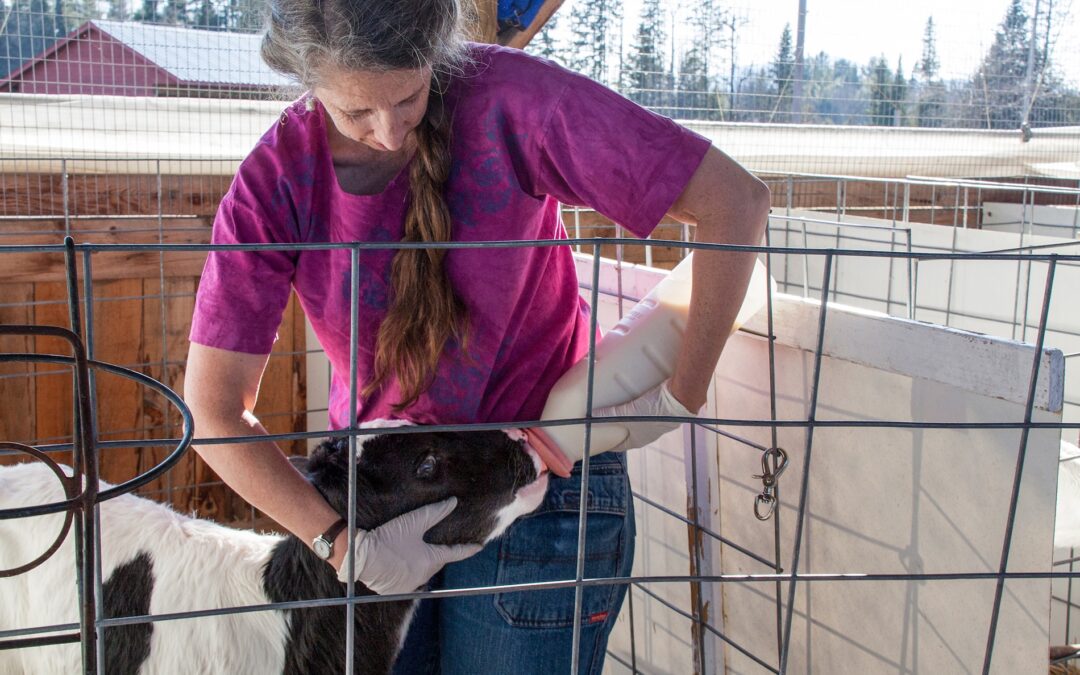
I first met Nancy Nottermann, one of the farmers in the book, at a singing camp. Listening to her describe the early life of the calves with the bottle feedings and constant handling and care, I realized that this was a story that needed to be told. It was a wonderful example of “how to do it right.” As a photographer, I knew the power of photographs tell the story.
2. In the book, we follow the life of Lima Bean, a calf born to a dairy cow. What typically happens to mothers and their babies on a factory dairy farm?
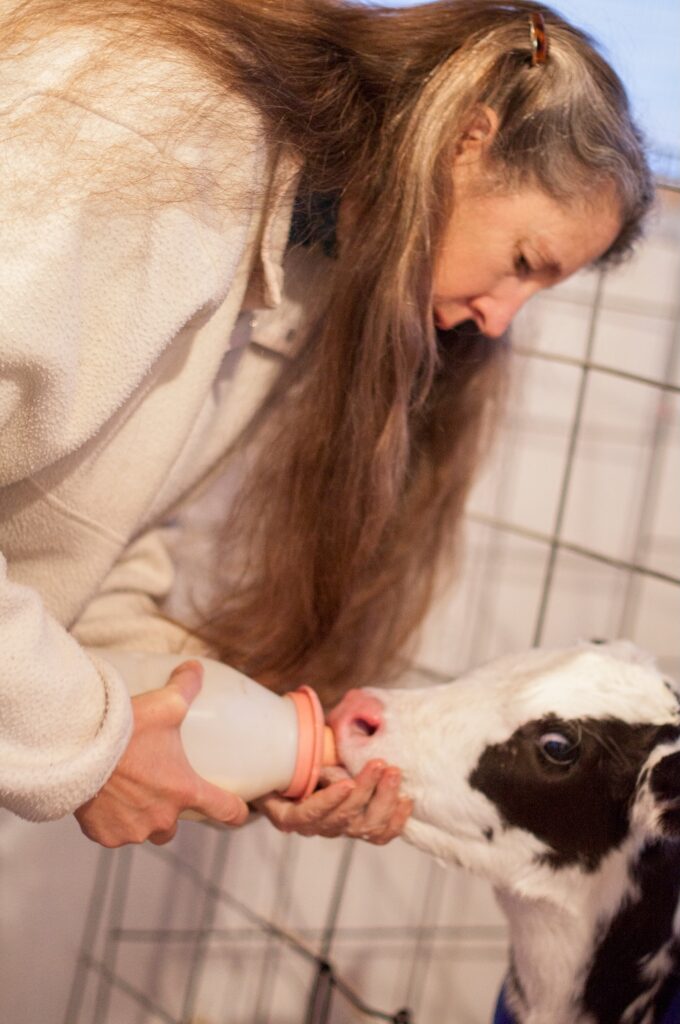
All calves are separated from their mothers shortly after birth. The heifers (female calves) are kept on the farm to join the dairy herd. The bulls (male calves) are generally sent off on a slaughter truck at 1-2 days old to be turned into hotdogs.
3. Some people don’t realize, that “farms” are not what they used to be when our parents were growing up. How has ‘farming” (i.e. factory farming) in the United States changed since the mid-20th century?
- Farms have become much larger and more specialized, focusing on intensive production of a single crop or animal type (“monoculture”), rather than the diverse, family-based farms common in the past.
- Most animals are now raised in highly crowded, indoor facilities controlled by a handful of multinational corporations—the top four companies control the majority share of beef, pork, and poultry markets.
- Mechanization and technology, including synthetic fertilizers, pesticides, and automated systems, have replaced traditional practices and reduced labor needs, leading to fewer and larger farms.
4. What are the consequences (impacts)?
Environmental Damage
- Factory farms produce massive quantities of untreated waste—13 times more than the entire U.S. population as of 2012—resulting in pollution of air, water, and land.
- Chemical runoff and manure lagoons from CAFOs contaminate rivers and streams; the EPA estimates pollution from these operations impairs about 40% of U.S. waterways.
- High greenhouse gas emissions (methane, carbon dioxide, and nitrous oxide) accelerate climate change, erode topsoil, and threaten habitats and endangered species.
Community and Social Costs
- Economic power is concentrated among a few corporations, leading to the loss of over 100,000 small farms in the past decade.
- Rural communities experience declining property values, worsening air quality, and pervasively unpleasant odors. Right-to-Farm laws and deregulation often reduce communities’ ability to oppose new factory farms.
- Workers (often immigrants) face unsafe conditions, exploitation, and lack of training, which increases risk of injury and health problems.
Animal and Human Health
- Animals endure crowded, stressful conditions with minimal welfare standards, increasing suffering and disease risk.
- Exposure to toxic gases like ammonia and particulate matter causes respiratory illnesses and has been linked to over 12,000 air-quality-related deaths per year in the U.S..
- Factory farms are breeding grounds for antibiotic resistance and zoonotic diseases, posing threats to public health.
5. The way the Nottermanns raise their animals is vastly different than how the majority of animals are raised on a factory farms. In the book you say: “Most of us do not have a direct connection with the animals who provide our food. Instead, we buy meat neatly wrapped in plastic at the grocery store. We even use words that distance us from animals we eat. We talk about eating ‘beef,’ not ‘cow’; we say ‘pork’ (or ‘bacon’), not ‘pig’.”
From big marketing campaigns to myths and ag gag laws to cultural norms, the majority of people don’t think twice about eating ‘meat’ or that it was even a sweet animal to begin with. How do we bridge this gap?
I think it starts with education—showing people where their food comes from and letting them see the difference between a farm like the Nottermanns’ and a factory farm. That might mean more farm visits, more honest storytelling, or even just changing the way we talk about meat so we remember it came from a living being.
In my own work, I’ve chosen to tell the story of the calf Lima Bean —following him from birth to adulthood—because I think it’s a gentle way to help people reflect on their choices without feeling attacked or shamed. When you can see that it is possible to raise animals humanely, care for the land, and still make a living as a farmer, it opens the door for people to imagine a better food system and to consider their own choices. Food policy changes one bite at a time — and every one of us has a seat at the table.
6. How have you changed your eating habits since writing this book?
I only eat ethically raised meat. By doing this, I use my food dollars to directly support farmers who are working hard—often against the tide—to raise animals in humane and sustainable ways. I refuse to fund the corporations behind the factory farm systems that is ethically bankrupt.
Most people don’t even realize there’s a difference in how animals are raised, which is why, whenever I can—whether I’m in a restaurant or a store—I start conversations and ask questions. My goal is to educate others about the life of the animal behind their meal. There a profound gap between a sentient being confined in cruel conditions and one that spends its life grazing on pasture
7. In what ways can people help our farmed animals?
1. The most important step you can take is to stop eating factory-farmed meat. It might not seem like much, but stores sell only what people will buy. Small health-food stores and food co-ops are more likely to carry humanely raised meat. When enough people (and, therefore, stores and restaurants) stop buying factory-farmed meat, the system will change. You vote with your fork every time you put food in your mouth.
2. Spread the word. Help spread the word. Every time you share why you refuse to eat factory-farmed meat, you’re educating those around you. If more people understood the reality of factory farming, most wouldn’t want to be part of such a cruel system. Every individual can make a difference, one bite at a time. Share this book. Or let your friends know they can read it for free at hamburgersdontgrowontrees.com.
3. Ask questions:
-
- Ask the places where you shop if they sell humanely raised meat, and if not, ask them if they would.
- Ask restaurants if they cook with humanely raised meat, and if not, ask them to do so.
- At farmers markets, ask farmers about the living conditions of their animals and try to arrange to visit farms to see them for yourself. Support farmers who are making the transition to more humanely raised meat. Many small-scale farms are doing their best to work towards this goal, and they need our support.
4. Be suspicious of labels. Animal Welfare Approved, a standard set by AGW (A Greener World), is the only certification that currently ensures high standards for humane treatment. Many other labels have no clear legal definition and are grossly misleading. Lack of oversight lets companies apply nice-sounding labels such as “certified humane” and “pasture-raised” on packages of meat from animals raised in conditions of abuse only slightly different from those of a factory farm. Even the “organic” certification for meat can be problematic as it doesn’t address animal welfare. Visit Farm Forward’s Animal Product Labeling Guide for the story behind the labels you see on meat products or Consumer Report’s Guide to Food Labels.
5. Try not to waste meat. If an animal died to feed us, the least we can do to honor that sacrifice is nourish our bodies with the meat, not throw it away. Of all the meat that Americans buy, twenty-two percent is discarded, mostly because people think it has gone bad due because they misunderstand labels. “Use by” and “best by” dates suggest peak quality. They do not mean that meat is bad past those dates. The easiest and fastest way to tell if meat is bad is to smell it: the scent of fresh meat is barely perceptible. Rancid meat, on the other hand, has a nasty, unpleasant smell and should not be eaten. Here are three other changes to stop waste—they just take a bit of planning.
-
- Encourage your family to plan menus so all meat purchased is eaten.
- Freeze meat before it spoils if it isn’t going to be eaten right away.
- Store leftovers from a meal and eat them later.
Remember, when you first make a significant change in how you eat, it is easy to get discouraged; the first steps are always the hardest. Remember the saying, “Don’t let perfection get in the way of progress.” We all face situations where the options for food are limited, or someone has made us a special meal and we are pretty sure it is with factory-raised meat. Then, we might make the choice to eat meat that we ordinarily would not. Just keep coming back to thinking about the animals. Cultivate gratitude and respect toward the animals that give us the gift of their lives for our food.
You can learn more and read Liza’s book, Hamburger’s Don’t Grow on Trees here.
Be sure to check out the comprehensive downloadable resources at the end of the book.